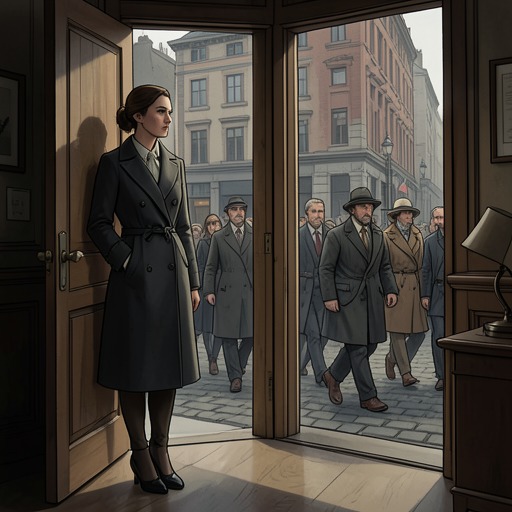
Carter recruits Tommy and Tuppence to run the International Detective Agency
Partners in CrimeCarter recruits Tommy and Tuppence Beresford to run the International Detective Agency, turning an apparently modest six-month experiment into both a public detective business and a cover for a sensitive operation. The appointment establishes the couple’s new working life, gives Tommy specific instructions about coded correspondence, and invites Tuppence into the investigative role that will shape the agency’s cases.
The Assignment and Its Conditions
Carter explains that the International Detective Agency has been near collapse and that a friend has acquired it for a negligible sum. The plan is to put the business back into operation for six months, during which it needs a manager. Its former manager, Theodore Blunt, cannot fill that role: he has been indiscreet, Scotland Yard has intervened, and he is being detained at public expense while refusing to disclose everything the authorities want to know.
Rather than appointing Tommy openly in his established capacity, Carter proposes six months’ leave on the stated ground of ill health. Tommy may run the agency under Blunt’s name, Carter says, without the arrangement being any concern of his. The formula gives the enterprise a ready-made identity while keeping Tommy’s official position separate from its public face. It is not simply a new job: it is an assignment whose usefulness depends on the distinction between what the agency appears to be and what its manager is doing for Carter.
Tommy asks whether there are instructions. Carter tells him to watch for letters bearing a Russian stamp and connected with a supposed ham merchant seeking his wife, who came to the country as a refugee years earlier. Moistening the stamp will reveal the number 16 written underneath. Tommy is to copy the letters and forward the originals to Carter; anyone who comes to the office and refers to number 16 must be reported immediately. The odd detail concealed beneath an ordinary postage stamp gives the new business a second, clandestine purpose and a precise procedure for identifying contact.
Carter adds that Tommy can run the agency as he pleases, then makes clear that the work is not intended for him alone: he thinks Mrs. Tommy might enjoy trying her hand at detective work. The invitation treats Tuppence’s participation as part of the plan, not as a merely domestic accompaniment to her husband’s appointment. Their partnership will be visible in the office and active in the investigations that follow.
Establishing the Agency
A few days later, the Beresfords take possession of the agency’s offices on the second floor of a dilapidated Bloomsbury building. The premises give physical form to the arrangement: a small outer office leads through separate doors marked for clerks and private business into the rooms where the supposed firm presents itself to callers. The shabby setting contrasts with the professional identity they are trying to establish.
Albert, who had previously played a Long Island butler, now becomes the office boy. He builds the part out of a paper bag of sweets, inky hands, and tousled hair, and performs it to perfection. The change makes the agency’s presentation a shared undertaking: Tommy and Tuppence are not the only ones adopting roles to make the new concern convincing.
Behind the private-office door, Tommy sits at a large businesslike desk amid artistically labelled but empty files and solid leather-seated chairs. A telephone is placed at his elbow, and he, Tuppence, and Albert have rehearsed the effects required to handle calls. The office is equipped to look established before it has acquired any clients; its polished professional trappings are, at the outset, a performance as much as a workplace.
Tuppence works in the adjoining room, with a typewriter and simpler furniture, as well as a gas ring for making tea. That practical detail brings the enterprise down from its imposing desk and empty files to the routine of a small household partnership. The room is ready for work, but the agency’s immediate lack is the one thing that would make the performance a functioning business: clients.
A Detective Partnership in Practice
The assignment gives Tommy a reason to think about the craft as well as its appearance. He describes himself and Tuppence as amateurs and begins studying detective stories by leading writers, intending to try different methods and compare the results. His plan is both earnest preparation and a comic acknowledgment that fictional detectives supply ready-made professional models for two inexperienced investigators.
Tuppence tests those models against practical limitations. When Tommy considers attempting the methods of Dr. Thorndyke, she points out his lack of medical and legal experience and doubts his scientific ability. Tommy answers that he has bought a camera and proposes photographing footprints and enlarging the negatives. Their exchange establishes the partnership’s working rhythm: Tommy reaches for technique and equipment, while Tuppence measures an appealing theory against what they can actually do.
That playful study develops into active role-playing. When Tuppence fears that their opponents have recognized Tommy is not the real Mr. Blunt, Tommy selects the roles of the Okewood brothers from the books on his shelf, declaring himself Desmond. Tuppence chooses Francis, whom she regards as the more intelligent brother and the one who arrives in disguise to rescue Desmond from trouble. Detective fiction is therefore more than a reading list: it offers the pair a repertoire of identities and a way of making sense of danger, even as their self-conscious performances expose the distance between literary convention and real risk.
Their repeated appeals to the “little grey cells” and to the imagined methods of famous detectives make the agency’s work deliberately theatrical. Tuppence invokes the phrase while interpreting a fireman’s kit and proposing her own disguise; Tommy later adopts the manner of Hercule Poirot while confronting the threat associated with number 16. Such play does not replace observation. In the later diplomatic-bag investigation, Tommy explains that he noticed a mismatch between a woman’s supposed role and her dismay when Albert performed a lasso act, then followed the implications of a bag being placed in an ambassador’s possession. The comic detective poses and the careful scrutiny coexist: the assignment makes performance a tool, but judgment still turns on concrete discrepancies.
The Operation Beyond the Office
The number 16 instruction points beyond ordinary private inquiries. In the later confrontation with the man who has used the identity of Inspector Dymchurch, Tommy sees the disguise collapse: the apparently typical English inspector proves to be a well-educated foreigner whose English has no trace of an accent. The transformation makes the danger already implicit in Carter’s coded instructions visible. Names, occupations, and outward manner can be constructed, and a reassuring official identity may conceal an enemy.
Tommy’s theory of disguise also becomes practical rather than merely theatrical. Discussing how a man could pass as a woman and then change back, Tuppence explains that a skirt over plus fours, a brown sweater, and a felt hat with attached curls could create the effect at a distance; the reverse change could take about a minute and a half. Her account makes costume a mechanism for movement and evasion, not just a comic accessory. The couple’s detective work depends on understanding how appearances can be assembled and altered.
The same emphasis on misdirection governs Tommy’s explanation of the diplomatic-luggage plot. He reasons that the crucial question is not why anyone would want the ambassador’s bag temporarily, but why someone would want a different bag in the ambassador’s possession. Since diplomatic luggage avoids customs examination, he concludes that it can be used for smuggling, and that the cargo must be small enough to conceal: drugs. The apparent attack in his office was staged to win his confidence in the woman involved, while the story meant to draw him away was intended to put him off the trail or remove him from it. His conclusion connects the staged agency encounter to the secret criminal scheme, showing how the firm’s public role allows a planted performance to become part of an investigation.
The peril of the work is clearest when the enemy’s own disguise carries out an abduction. After Tuppence disappears, Tommy finds a bundle beneath the sofa containing the long black coat she had worn, her walking dress, her hat, and a long fair beard. The clothes reveal a prepared exchange of identities, while a fragment of hypodermic needle confirms that she was drugged rather than persuaded to cooperate. The agency’s world of aliases and costumes has crossed into physical violence: the same unstable appearances that make the Beresfords effective investigators can be turned against them.
Significance of the Recruitment
Carter’s offer binds together three strands that define the enterprise: a failing business restored under a borrowed name, a covert channel marked by the number 16, and a married pair invited to work as equals in detective play. The office’s empty files and rehearsed telephone calls initially make the firm look more complete than it is; the coded letters make its apparent routine potentially dangerous; and the couple’s habit of borrowing fictional detective roles turns the work into a contest between performance and evidence.
The recruitment thus serves as the narrative’s enabling event. It supplies a base from which the Beresfords can receive cases and investigate, while placing them inside a larger secret operation whose opponents also rely on false identities. What begins as six months’ leave and an improvised office becomes a sustained test of whether the couple can distinguish a convincing part from the truth it is meant to conceal.